
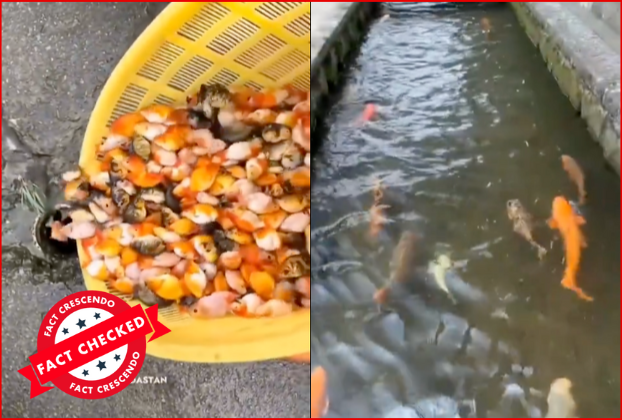

Videos showing koi fish living in Japanese drainage systems have gone viral on social media. These posts claim Japan’s drainage systems are extraordinarily clean and uniquely house koi fish. The posts have sparked widespread discussions about Japan’s infrastructure and environmental practices.
Social Media Posts
Multiple Facebook users have shared a video showing someone pouring hundreds of fish into a drainage system. The video then cuts to footage of koi carp swimming in a Japanese drainage canal, with captions claiming that Japan uses koi to maintain clean drainage systems.
Similar claims have circulated that Japan’s drainage systems are clean enough for koi fish to thrive.


Fact-Check
Video Analysis
An analysis of the video reveals that the fish released into the drainage at the beginning of the clip are goldfish, not baby koi.

Young koi fish look noticeably different from the fish that appear in the video

Differences between Goldfish and Koi Fish
Goldfish: Have shorter, rounder bodies and no facial barbels. Breeding-ready males develop small tubercles on their gill covers (operculum) and pectoral fins, while females do not.
Koi Fish: Have square-shaped heads, elongated bodies, and two prominent pairs of barbels beneath their mouths. However, an emaciated goldfish may appear similar to a koi when viewed from certain angles (Source).
Analysis of the video clip shows that the fish display characteristics more consistent with goldfish than koi fish.
Environmental Impact
Releasing goldfish into non-native water bodies can lead to several serious environmental problems:
- Becoming an Invasive Species: Goldfish reproduce rapidly and outcompete native fish for resources, disrupting the natural ecosystem balance
- Habitat Destruction: Overpopulation of goldfish can degrade the water body’s environment and harm existing wildlife
- Cross-breeding: Goldfish can interbreed with native fish species, weakening local populations through genetic dilution
Drainage pipes are designed to drain water from areas, not serve as habitats for fish. When fish are released into these pipes, they encounter an environment devoid of oxygen and essential nutrients necessary for survival, likely leading to their quick death. This practice contradicts the goal of maintaining cleanliness—dead fish in the pipes would actually increase odor and pollution.
Moreover, no credible documentation or reports from authoritative sources, including Japanese government bodies like the Ministry of Environment or local authorities, support the claim that fish were ever used to prevent wastewater dumping. This appears to be an unsubstantiated story lacking both historical evidence and policy backing.
Shimabara’s Iconic Canals
Shimabara, a city on Kyushu Island, is famous for its clean drainage canals where colorful koi carp swim freely. These clear waterways exist because of the 1792 Mount Unzen earthquake and tsunami, which created natural freshwater springs in the area. In 1978, the city added koi carp to these canals, turning Shimabara into the “City of Swimming Carp.” Today, local residents work together to keep these waterways clean and ensure the koi remain healthy. (Source: 1, 2)
Challenges Faced by Japan’s Drainage System
While Shimabara is known for its clean canals, other Japanese cities struggle with water quality issues. Many urban areas have problems with untreated wastewater flowing into their waterways – less than 60% of lakes meet environmental standards. Rivers are affected by pollution from farms and factories.
The situation is made worse by old infrastructure, as 16% of sewer systems have been in use for over 50 years, leading to leaks and ground collapse. Even with modern monitoring equipment, limited funding and workforce make it difficult to keep drainage systems working effectively across Japan. (Source: 1, 2, 3)
Summary
The claim that Japan’s drainage systems are remarkably clean, allowing fish like koi to thrive, holds true in specific locations such as Shimabara. However, this is not a nationwide standard.
Different parts of Japan tell different stories, while some cities have very clean waterways, others struggle to maintain their water systems. Although Japan is known for being clean and having good technology, the condition of its drainage systems really depends on local geography, history, and available resources.

Title:Are Japan’s Drainage Systems Clean Enough for Koi Fish to Thrive?
Fact Check By: Cielito WangResult: Missing Context