
Subscribe to our WhatsApp Channel
As Sri Lanka argues over how much its economic recovery has reached ordinary households, businessman and politician Dilith Jayaweera set off a fresh debate on live television. Appearing on Siyatha TV’s “Thrikonaya” programme, he said the share of the impoverished class backing the current government had doubled, a claim widely read as meaning three out of every four ordinary Sri Lankans are now poor. The statement spread quickly on social media. Here is the post, and what the official numbers actually say.
Social Media Posts

Prompted by reader requests to check whether the statement was accurate, we set out to verify it.
Fact-Check
Sarvajana Balaya party leader and Member of Parliament Dilith Jayaweera appeared on the “Thrikonaya” programme on Siyatha TV on September 2. He discussed the 22nd Constitutional Amendment and judicial independence, the government’s actions and the economy, and his party’s future agenda. Mr. Jayaweera also said the share of the impoverished class that voted the current government into power had doubled during this term, and that one in four people had fallen into extreme poverty while, overall, three out of every four had become poor. The relevant portion of the programme is here.
To test the claim, we examined the latest official data from the Department of Census and Statistics (DCS), the World Bank, and the Central Bank of Sri Lanka, and tested the 75% figure on its own terms against the official results of the two national elections that brought the government to power.
What the Department of Census and Statistics Data Shows
Sri Lanka’s chief institution for compiling official poverty statistics is the Department of Census and Statistics. It measures poverty using data such as the Household Income and Expenditure Survey (HIES). The national official poverty line published by the DCS for July 2026 stands at Rs. 17,679 per person per month. This figure is not the share of people in poverty; it is only the threshold used to measure poverty. According to the DCS, the national poverty rate was 14.3% in 2019. That 2019 figure remains the most recent officially published national poverty rate, as the poverty indicators from the 2025 HIES are not expected until the end of 2026 (October to December).
What the World Bank Estimates Show
World Bank estimates also indicate poverty rose significantly after the economic crisis. According to the World Bank’s Sri Lanka Development Update 2025, using the international poverty line of US$3.65 per person per day (2017 PPP), the poverty rate was estimated at 24.5% in 2024, up from 11.3% in 2019 under the same method, roughly double.
The MP’s related phrasing, that one in four people are in extreme poverty, also mislabels the measure. Extreme poverty, defined by the World Bank at the US$2.15-a-day line (2017 PPP), stood at about 1% of the population in 2019. The 24.5% and 65.8% figures are the lower-middle-income and upper-middle-income comparison lines, not measures of extreme poverty, so “one in four in extreme poverty” applies the wrong benchmark.
Has Poverty Increased Since the Current Government Came to Power?
It is true that poverty in Sri Lanka rose sharply after the economic crisis. The World Bank notes that poverty in 2024 was nearly double the 2019 level, estimated at 24.5% against 11.3%. But the suggestion that poverty doubled “since the current government came to power” is misleading. The 24.5% figure is for 2024, and the current government only assumed office in late 2024, so the increase largely traces to the 2022 to 2023 crisis period that predates this administration. The 24.5% is also an estimate for 2024, not an official poverty rate for 2026. An earlier 2024 World Bank Development Update projected the poverty rate would remain above 22% through 2026, but that is a projection, not a measured 2026 figure.
Testing the Claim on Its Own Terms
Mr. Jayaweera did not describe the country as a whole. He tied the figure to the government’s own base, saying the impoverished share among those who voted the current government into power had doubled, so that three of every four are now poor. Two things follow from reading it that way.
First, poverty is not measured by how people vote. Neither the Department of Census and Statistics nor the World Bank breaks its poverty figures down by party or candidate, so no survey can establish a poverty rate for “government voters” as a group. That link is rhetorical, not statistical.
Second, even if the claim is granted its own terms, the arithmetic does not hold. According to the Election Commission of Sri Lanka, the National People’s Power won 6,863,186 votes at the parliamentary election of 14 November 2024, and Anura Kumara Dissanayake took 5,634,915 first-round votes at the presidential election of 21 September 2024. If three-quarters of the government’s parliamentary voters were poor, that would be about 5.1 million people; three-quarters of the presidential first-round vote would be about 4.2 million. In share terms, poor government supporters alone would come to about 46% of the valid votes cast at the parliamentary election, and about 32% at the presidential one, before counting a single poor person who voted for anyone else.
Now set that against the actual scale of poverty. The World Bank’s most recent estimate, 24.5% for 2024, works out to roughly 5.3 million poor people in a population of about 21.8 million. For 5.1 million of them to be government voters, as the parliamentary version of the claim requires, almost every poor person in the country, on the order of 96%, would have had to vote for the government, leaving next to none among the roughly 15 million Sri Lankans who did not. Because poverty plainly is not confined to the government’s supporters, the rate the claim implies would be higher still, a third or more of the population. Nothing in the official record, from the DCS national rate of 14.3% in 2019 to the World Bank’s 24.5% in 2024, comes near it. The claim collapses on its own logic.
Prof. Wasantha Athukorala, University of Peradeniya
Speaking to us, Prof. Wasantha Athukorala of the University of Peradeniya’s Department of Economics said that by 2022 Sri Lanka’s poverty level had risen to about 25%, and that information since then indicates it has gradually declined to its current level. His account is consistent with the crisis-era spike in poverty and a partial recovery afterwards, rather than the population of which three of every four people are poor.
Join us to learn more about our fact-check investigations.
Facebook | Twitter | Instagram | Google News | TikTok | YouTube
Conclusion
The data clearly show that poverty in Sri Lanka rose significantly after the economic crisis, roughly doubling between 2019 and 2024. That real and painful trend is the defensible core of what Mr. Jayaweera described. But there is no official figure or recognized poverty estimate placing three of every four Sri Lankans.
Under the standard US$3.65-a-day measure the World Bank estimated 24.5% for 2024, and the most recent official national rate from the Department of Census and Statistics is 14.3% for 2019.
The claim fares no better on its own terms: three-quarters of the government’s parliamentary voters would be about 5.1 million people, nearly the entire poor population the official rate implies, so the figure holds only if almost every poor Sri Lankan is a government voter.
And the sharp rise traces to the 2022 to 2023 crisis, before this administration took office in late 2024, so the suggestion that poverty doubled “since the current government came to power” misplaces the timing.
Prof. Wasantha Athukorala placed the peak at about 25% in 2022, easing since.
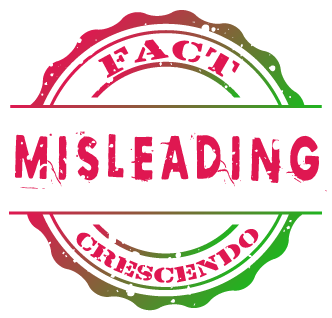
For these reasons we rate the claim Misleading: it stretches a genuine rise in hardship into a specific figure that no official source supports and ties it to the government’s voters in a way the statistics cannot bear.

Title: No Official Data Supports Dilith Jayaweera’s Claim That Three in Four of the Government’s Voters Have Become Poor
Fact Check By: Pavithra Sandamali
Result: Insight